The problem
What the system addresses
LLM automation becomes difficult to operate when long-running work, retries, approvals, and state are hidden inside a request-response cycle.
Independent system / 04 / Expert-led automation
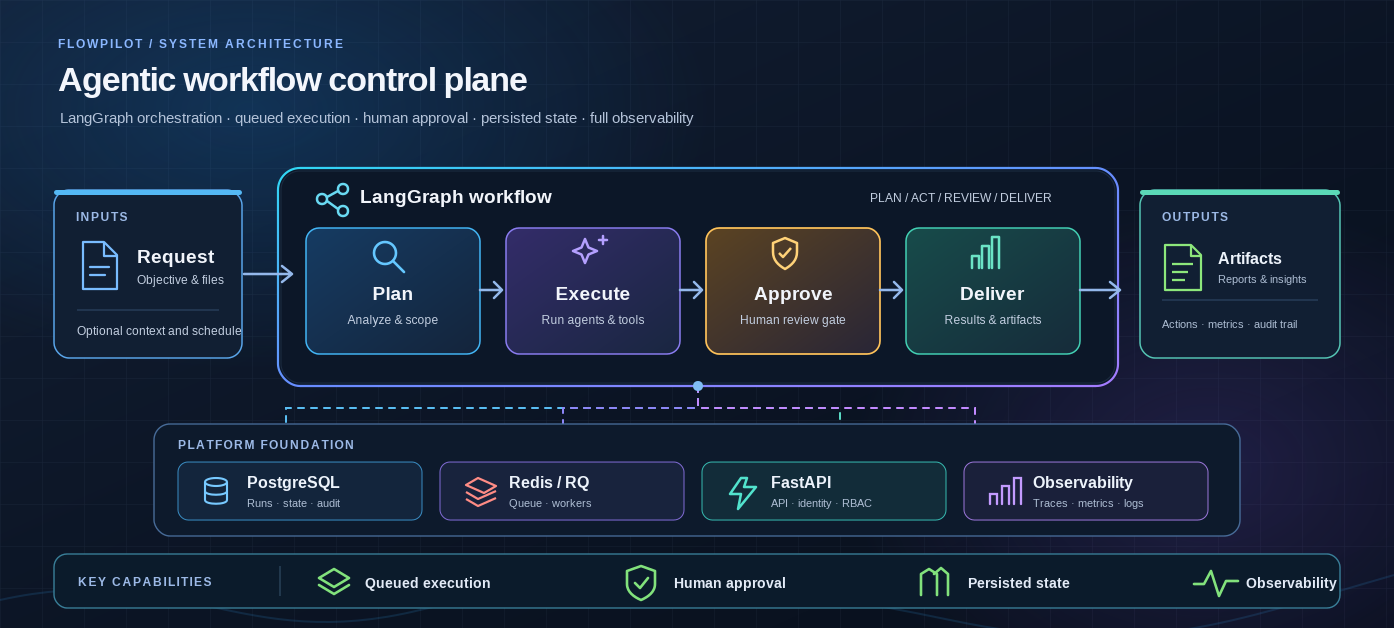
An expert-led workflow control-plane demonstration that moves long-running tasks through queued workers, persisted state, human approval and observable results. It shows how orchestration, execution, validation and operational visibility can be separated instead of hiding everything inside a synchronous prompt.
Independent engineering build · Not a client case study
The problem
LLM automation becomes difficult to operate when long-running work, retries, approvals, and state are hidden inside a request-response cycle.
The implementation
Separate orchestration from execution, persist workflow state, and expose progress and approval boundaries explicitly.
Who it is for
Coordinate asynchronous AI workflows with queued execution, human approval, persisted state and observable outcomes.
Independent engineering build. This reference is not a client case study; no customer deployment, testimonial or business-outcome metric is claimed.
Inspectable implementation evidence
Local validation snapshot · 16 November 2026 · Docker Compose
A first competitor run was submitted while LiteLLM was still becoming reachable and failed with a connection error. After the services were ready, the competitor workflow was replayed successfully and all four named smoke checks completed. This is a dated local validation snapshot, not a production-availability or customer-outcome claim.
System map
Implementation detail
Build notes
AI automation becomes difficult to operate when long-running work, retries, approvals, and state live inside fragile synchronous requests.
Build a production-minded AI automation control plane that treats experts as durable workflows instead of isolated prompts.
Optional technical workbench
The homepage contains no-key synthetic walkthroughs. The advanced workbench is optional and requires your own provider API key for live model requests. Hosted demonstrations may take a moment to wake from an idle state. Use synthetic or non-confidential data only; provider usage may incur charges.
TECHNICAL LAB / LIVE MODEL WORKBENCH
Use your own provider API key to run live model requests against the selected engineering demonstrations. The interactive module loads only when you open it, keeping the rest of the page lightweight.
Use a test key with a spend limit and synthetic or non-confidential data. Never enter production credentials or sensitive business information. Hosted demonstrations may take a moment to wake after inactivity, and provider usage may incur charges on your account.
Coordinate asynchronous AI workflows with queued execution, human approval, persisted state and observable outcomes.